

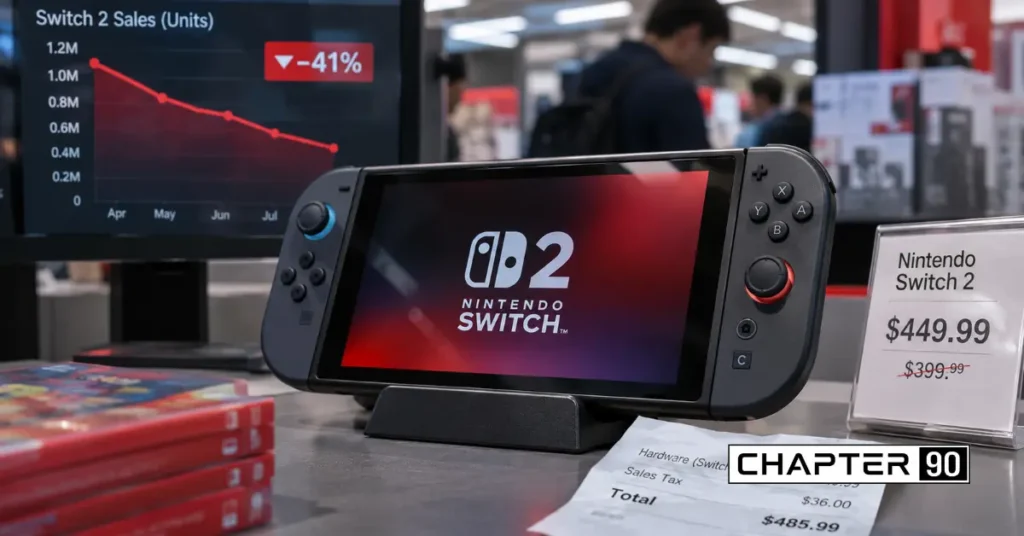
Nintendo Switch 2 sales fell 41.2% year over year in the July to September 2026 quarter, with Nintendo selling 2.67 million consoles compared with 4.54 million during the same period in 2025. The results, announced on November 5, showed weaker hardware demand alongside growing pressure from memory-chip costs. However, Nintendo’s 2026 earnings also revealed a surprising contrast. Despite the Switch 2 sales decline, the company reported a 49.1% increase in operating profit for the first six months of its financial year.
The figures raise questions about the console’s momentum after its successful 2025 launch, especially as higher prices and manufacturing costs pressure the gaming industry.
Nintendo has maintained its annual hardware sales target of 16.5 million Switch 2 consoles. Whether it reaches that figure will depend heavily on holiday demand and the performance of its upcoming games.
Key Takeaways
- Nintendo sold 2.67 million Switch 2 consoles during July to September 2026, down 41.2% from the same quarter a year earlier.
- The company sold 6.49 million Switch 2 consoles during the first half of its financial year, a decline of 37.4%.
- Nintendo’s operating profit increased 49.1% to ¥216.5 billion during April to September, supported by software sales and US tariff refunds.
- Rising memory-chip costs and tariffs remain major pressures on Nintendo’s hardware business.
- Nintendo Switch 2 software sales increased 18.8% to 24.49 million units during the six-month period.
- Nintendo maintained its forecast of 16.5 million Switch 2 hardware sales for the fiscal year ending March 31, 2027.
How Much Did Nintendo Switch 2 Sales Fall?
Nintendo’s November 5 financial presentation confirmed that sales of its latest gaming console slowed considerably during the July to September quarter.
The company sold 2.67 million Switch 2 systems during the three months ending September 30, compared with 4.54 million during the equivalent quarter in 2025.
That represents a 41.2% year-on-year decline.
Nintendo hardware sales also decreased compared with the immediately preceding quarter. Between April and June 2026, the company sold 3.82 million Switch 2 units, approximately 30.1% more than during July to September.
The figures provide a clearer picture of the Switch 2 sales decline than a single percentage headline.
Nintendo Switch 2 Quarterly Sales Comparison
| Reporting Period | Switch 2 Units Sold |
| July to September 2025 | 4.54 million |
| April to June 2026 | 3.82 million |
| July to September 2026 | 2.67 million |
Nintendo reports these figures using a measure known as sell-in. This mainly reflects units supplied to business partners, including retailers, alongside direct consumer sales through Nintendo’s own channels.
It does not mean every console included in the figures has already been purchased by an individual customer.
That distinction matters when comparing Nintendo hardware sales with consumer demand data from retail research companies.
Why the 2025 Launch Comparison Matters
Nintendo Switch 2 launched in June 2025, creating an unusually strong starting point for year-on-year comparisons.
The following July to September quarter benefited from early demand for the new console, including customers who had waited for the successor to the original Switch.
As a result, the Switch 2 sales decline in 2026 is being measured against a period when the product was still relatively new.
A slowdown from that initial launch period does not automatically mean the console has lost its long-term appeal.
Nintendo had sold 26.35 million Switch 2 consoles worldwide by September 30, 2026.
The challenge now is maintaining demand beyond the initial group of enthusiastic buyers.
Future Nintendo hardware sales will increasingly depend on game releases, household budgets, pricing, and the company’s ability to attract customers who have not yet upgraded.
What Nintendo’s Latest Earnings Reveal
The latest Nintendo financial results show that hardware demand is only one part of the company’s financial performance.
For the six months ending September 30, 2026, Nintendo reported net sales of ¥966.0 billion, down 12.1% from the previous year.
At the same time, Nintendo’s operating profit rose 49.1% to ¥216.5 billion.
Net profit increased 11.0% to ¥220.9 billion.
These results highlight an important distinction between selling more products and earning more profit from the products sold.
Nintendo Earnings Comparison
| Financial Metric | April to September 2026 | Annual Change |
| Net sales | ¥966.0 billion | Down 12.1% |
| Operating profit | ¥216.5 billion | Up 49.1% |
| Ordinary profit | ¥300.6 billion | Up 27.4% |
| Net profit | ¥220.9 billion | Up 11.0% |
| Switch 2 hardware sales | 6.49 million units | Down 37.4% |
| Switch 2 software sales | 24.49 million units | Up 18.8% |
Source: Nintendo’s official six-month earnings release
The Nintendo financial results also showed that the company’s operating profit margin increased from 13.2% to 22.4%.
This suggests a more favorable earnings mix across the first half, even while total revenue declined.
However, the improvement was not entirely the result of normal software operations.
A substantial tariff refund also contributed to profitability.
Why Quarterly and Six-Month Profits Tell Different Stories
The Nintendo earnings 2026 figures become more interesting when the reporting periods are separated.
During July to September alone, operating profit fell approximately 16% to ¥73.9 billion.
That result missed market expectations of approximately ¥88 billion, according to financial reporting published on November 5.
Yet operating profit for the entire April to September period increased significantly.
The difference largely reflects a much stronger April to June quarter, when Nintendo benefited from software demand and a refund related to previously paid US tariffs.
Investors should therefore avoid assuming that Nintendo operating profit increased in every quarter.
The six-month improvement is genuine, but it does not remove the pressure visible in the latest three-month results.
This distinction is essential when interpreting Nintendo’s quarterly earnings and evaluating the company’s financial outlook.
Why Are Nintendo Switch 2 Costs Rising?
Nintendo faces increasing production expenses as memory-chip prices and other component costs put pressure on the wider electronics industry.
The issue affects gaming consoles because manufacturers must purchase processors, memory, storage components, and other hardware before selling their products.
If those components become more expensive, companies may face narrower profit margins unless they reduce costs or increase retail prices.
Nintendo memory chip costs have become particularly relevant as demand for advanced computing infrastructure increases.
In its financial forecast, Nintendo included an estimated ¥100 billion impact from rising component prices, particularly memory, and tariff measures combined.
The figure does not represent memory costs alone.
How Memory Prices Affect Gaming Hardware
Memory plays an essential role in modern gaming consoles.
RAM helps a system run games and manage information quickly, while storage memory holds installed games, system files and other data.
Higher memory chip prices can therefore increase the manufacturing cost of each console.
Demand from artificial intelligence infrastructure has also placed pressure on parts of the global memory market.
In May 2026, Reuters reported on rising memory prices across the electronics industry, including the challenges facing Nintendo and Sony.
The connection does not mean every type of memory used in a gaming console is identical to the memory installed in an AI server.
However, competition for manufacturing capacity and broader supply-chain pressures can affect multiple technology industries.
Nintendo’s rising memory-chip costs are particularly significant because console manufacturers must balance affordable pricing with sustainable hardware profit margins.
The effects extend beyond gaming. Chapter Ninety has also examined AI data center restrictions and the investment challenges facing large technology infrastructure projects.
Those local development restrictions are a separate issue from Nintendo’s component purchases, but both stories illustrate how physical infrastructure and supply constraints can influence technology businesses.
Is Nintendo Planning Another Switch 2 Price Increase?
The Nintendo Switch 2 price has already increased in several markets during 2026.
In the United States, Nintendo raised the standard console’s suggested retail price from $449.99 to $499.99 on September 1.
The company announced that change in May, citing longer-term shifts in market conditions.
Nintendo also introduced price increases in Japan and parts of Europe.
Despite those earlier increases, Nintendo President Shuntaro Furukawa said on November 5 that the company was not considering another price adjustment at that time.
He also indicated that Nintendo expected to secure sufficient memory supplies.
The statement provides some reassurance for consumers, but it is not a permanent guarantee that the Nintendo Switch 2 price will remain unchanged.
Future decisions could depend on manufacturing costs, exchange rates and market conditions.
Importantly, the higher US price applied only during the final month of Nintendo’s July to September reporting period.
It would therefore be misleading to attribute the entire quarterly sales decline to that price change.
The Nintendo Switch 2 price may influence future purchasing decisions, but the company has not established that it caused the full 41.2% decline.
How Nintendo Increased Profits Despite Weaker Hardware Sales
Nintendo’s financial performance reflects a business model that extends well beyond selling consoles.
Hardware creates a platform for game purchases, downloadable content, subscriptions, and other services.
Once customers own a console, Nintendo can continue earning revenue through software and digital products.
This is one reason Nintendo’s operating profit does not always move in the same direction as Nintendo hardware sales.
Stronger Software and Digital Revenue
Nintendo Switch 2 software sales increased 18.8% to 24.49 million units during the first six months of the fiscal year.
The figure was supported by both new releases and continued interest in established franchises.
Nintendo reported the following sales for major Switch 2 titles during the period.
- Splatoon Raiders sold 2.42 million units.
- Fire Emblem Fortune’s Weave sold 1.34 million units.
- Star Fox sold 1.17 million units.
- Mario Kart World continued attracting customers after its earlier release.
The company also benefited from software purchases for the original Nintendo Switch.
For example, Tomodachi Life Living the Dream sold 8.81 million units during the six-month period.
Nintendo Switch 2 software sales are particularly relevant to the company’s profitability because software revenue can contribute differently to earnings than hardware revenue.
Digital sales provide another important part of the picture.
Nintendo reported digital revenue of ¥249.6 billion, up 60.5% year over year.
Digital transactions accounted for 60.7% of the company’s dedicated gaming-platform software sales, compared with 54.5% a year earlier.
This includes downloadable versions of packaged games, digital-only software, downloadable content and Nintendo Switch Online.
Growth in Nintendo digital sales shows that existing console owners continue to spend money within the company’s gaming ecosystem.
However, digital sales growth should not be confused with growth in total corporate revenue, which declined during the period.
The Contribution From Tariff Refunds and Entertainment
Nintendo’s first-half profit improvement also benefited from an unusual financial item.
The company recorded approximately $300 million in refunds related to US tariffs imposed under the International Emergency Economic Powers Act.
Nintendo accounted for the refunds as a reduction in cost of sales during the April to June quarter.
According to the company’s financial presentation, those tariffs had primarily been absorbed by Nintendo rather than passed directly to consumers through product prices.
That refund helped improve reported profitability.
The company’s intellectual-property business also performed strongly.
Revenue from intellectual-property-related activities rose 87.9% to ¥62.7 billion, supported partly by the commercial performance of The Super Mario Galaxy Movie.
Nintendo’s entertainment business includes activities such as film-related income, licensing and merchandise.
These revenue streams show why Nintendo’s financial performance cannot be judged solely by console shipments.
For a fair assessment, readers must consider software sales, digital services, entertainment income and one-off accounting effects together.
Why Nintendo Kept Its 2027 Switch 2 Sales Forecast
Despite slower quarterly demand, Nintendo maintained its annual target of 16.5 million Switch 2 consoles for the fiscal year ending March 31, 2027.
The Nintendo Switch 2 sales forecast was unchanged from the outlook issued earlier in 2026.
The company also retained its forecast of ¥370 billion in full-year operating profit.
During April to September 2026, Nintendo sold 6.49 million Switch 2 consoles.
That leaves approximately 10.01 million units to reach its full-year hardware target.
This remaining figure is a calculation based on Nintendo’s disclosed results and guidance, not a separate company forecast.
The Sales Challenge for the Next Six Months
Nintendo sold approximately 9.50 million Switch 2 consoles during October 2025 to March 2026.
To reach its current annual forecast, it would need approximately 10.01 million units during October 2026 to March 2027.
That means the required second-half sales volume is about 5.4% higher than the equivalent period a year earlier.
This is an important contrast.
Although first-half Nintendo Switch 2 sales were down 37.4% year over year, achieving the full-year target would require a stronger second-half performance than the same period in the previous financial year.
Nintendo has not guaranteed that this will happen.
The calculation simply shows what its unchanged forecast implies.
Why the Holiday Shopping Season Matters
Nintendo holiday sales have historically benefited from gift buying and new game releases.
For the Switch 2, the October to December quarter is especially important because the company must attract consumers beyond its original launch audience.
Higher retail prices could affect families considering whether to purchase a new gaming system.
At the same time, popular games and seasonal promotions may encourage purchases.
Nintendo sold 7.01 million Switch 2 consoles during October to December 2025, illustrating the importance of the holiday period.
Nintendo’s holiday sales in 2026 will help determine whether the company remains on course to meet its annual target.
However, the 2025 figure does not guarantee a similar result this year.
The Nintendo Switch 2 sales forecast also depends on purchases during the final quarter ending March 31, 2027.
Can New Nintendo Games Support Console Demand?
Nintendo is relying partly on software releases to encourage additional Switch 2 purchases.
The company launched The Legend of Zelda: Ocarina of Time in November 2026 and released a special 40th anniversary Switch 2 edition in October.
Its financial materials also list Metroid Ravenous for January 2027.
New titles can create additional reasons for existing Switch owners to upgrade, particularly when games are exclusive to newer hardware.
Popular franchises may also support software spending among customers who already own the system.
That matters because Nintendo Switch 2 software sales contribute to the company’s wider business even when hardware growth slows.
The Nintendo Switch 2 sales forecast therefore depends on more than production capacity.
Game availability, consumer spending and the perceived value of the console will all influence future demand.
What Do the Results Mean for Nintendo Investors?
Nintendo’s earnings present a mixed picture for investors.
Hardware sales have slowed, quarterly operating profit missed market expectations, and manufacturing costs remain elevated.
However, software performance, digital revenue and broader entertainment income provide sources of financial strength beyond console shipments.
The Nintendo stock outlook depends on how investors balance these developments.
A company can report improving six-month profit while still facing pressure in its most recent quarter.
For Nintendo, the main question is whether its software business can continue supporting earnings while hardware demand moves beyond the initial launch period.
The Main Risks and Positive Signals
| Potential Risks | Positive Signals |
| Slower Switch 2 hardware sales | Growing Switch 2 software sales |
| Higher memory and component costs | Stronger digital revenue |
| Increased retail prices | Popular Nintendo game franchises |
| Uncertain holiday demand | Unchanged annual sales forecast |
| Pressure on hardware margins | Broader entertainment and licensing income |
The Nintendo stock outlook also depends on developments that cannot be determined from the latest earnings release alone.
Investors may want to watch consumer purchasing trends, component costs, software attach rates, and changes to management guidance.
An additional detail in the Nintendo financial results deserves attention.
The company’s inventories increased from approximately ¥539.8 billion at March 31, 2026, to ¥814.6 billion at September 30.
The increase reflects the value of inventory held across the business. It should not be interpreted as proof that the entire rise consists of unsold Switch 2 consoles.
Nevertheless, inventory levels are worth monitoring alongside Nintendo holiday sales and future hardware demand.
The Nintendo stock outlook remains sensitive to whether the company can translate its established gaming franchises into sustainable profits under higher manufacturing costs.
What Should Readers Watch Next?
The next few months will provide stronger evidence about whether the Switch 2 sales decline represents a temporary slowdown or a more persistent challenge.
Several developments deserve attention.
- Further management commentary may provide additional insight into Nintendo’s pricing strategy, production costs and consumer demand.
- Holiday shopping results will show how consumers respond to higher console prices and new games.
- Memory-chip costs will remain relevant to manufacturing margins and future production decisions.
- Software releases may influence how many new customers purchase the console.
- Inventory trends could help investors assess how supply is changing alongside demand.
- Updated company forecasts will indicate whether Nintendo still expects to meet its financial-year targets.
The next Nintendo financial results will also help clarify whether the company can sustain software growth and manage component expenses.
Readers following Nintendo earnings in 2026 should pay particular attention to the difference between reported hardware shipments and consumer purchasing trends.
The Nintendo Switch 2 sales forecast remains unchanged, but the coming holiday quarter will be a meaningful test of that outlook.
Conclusion
Nintendo Switch 2 sales fell sharply during July to September 2026, but the company’s wider earnings picture is more complex than the hardware decline suggests.
Strong software performance, growing digital revenue and US tariff refunds helped lift first-half profitability even as quarterly operating profit weakened.
Rising component costs, the higher console price and uncertain holiday demand remain challenges for Nintendo.
The company has maintained its annual sales outlook, making the next reporting periods especially important.
Follow Chapter Ninety for the latest technology news, business developments, and clear analysis of the companies shaping global markets.